
Content note: Some linked resources include graphic descriptions and images.
Anyone who has watched a rabbit knows these animals are full of personality. At Animal Place, the rabbits in our care are curious, opinionated, and affectionate once they feel safe.
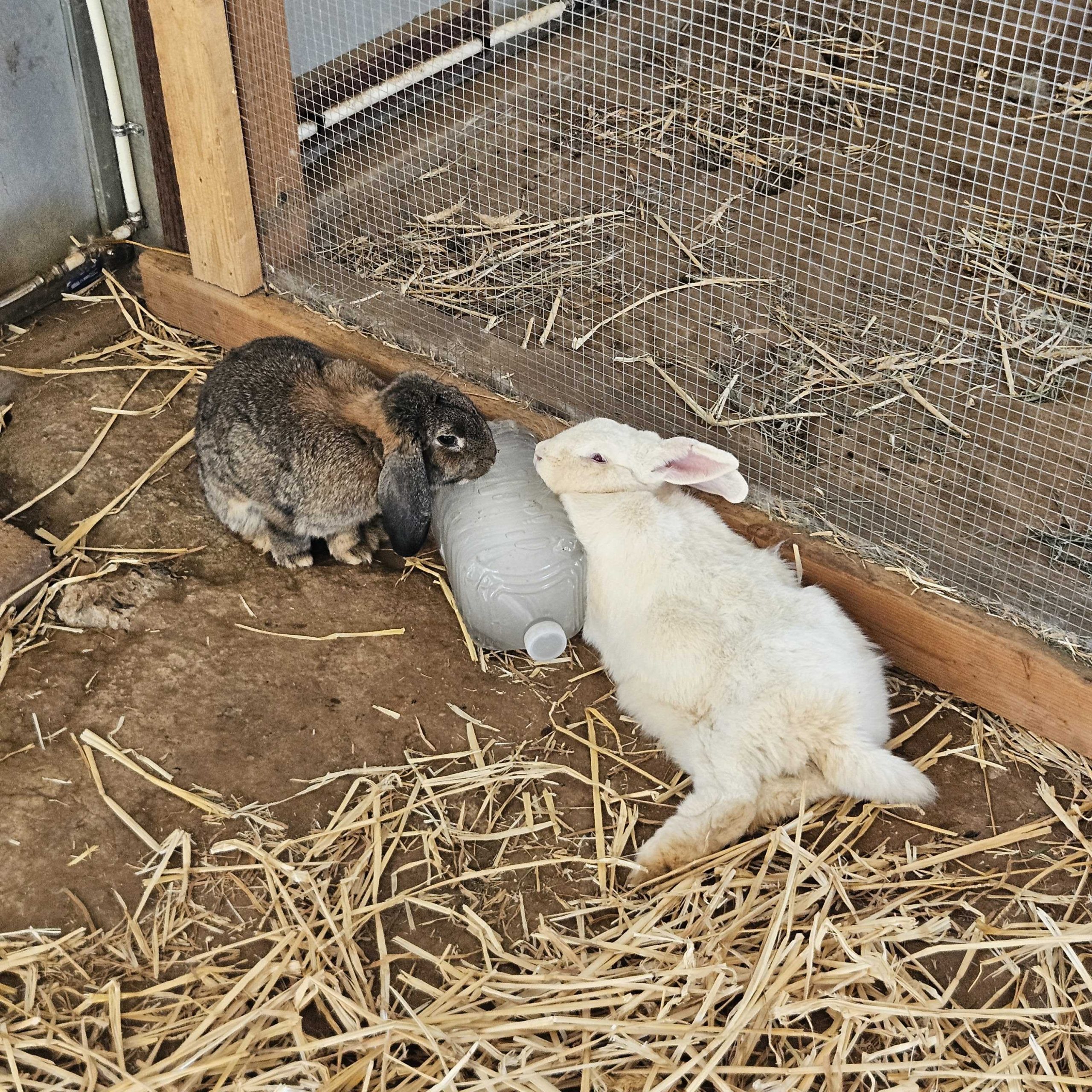
Animal Place resident Leon (AKA Liquid Leon) is our greeter in the Bunny Barn. He welcomes pets, and melts into the ground beneath him when he is completely relaxed.
Rabbits are one of the most popular companion animals in the U.S., yet they’re also among the most exploited animals in the world. They are used in laboratories, raised on fur farms, and slaughtered for meat by the hundreds of millions each year. Here’s how that happens, and what you can do to help.
Rabbits in Animal Testing: The Hidden Cost of Cosmetics
Testing on rabbits began in the late 1920s. Today, rabbits are still used to test cosmetics and household products, even though this testing is not medically necessary. In eye irritation tests, a substance is squirted in a rabbit’s eyes while the rabbit is held in a restraint device. In skin tests, chemicals are applied to shaved skin to measure irritation and corrosion. These tests are often done without pain relief, and the rabbits are typically killed when the study ends.
Rabbits are extremely sensitive to smells and even common household products. Soaps and scented products that may not bother your dog or cat can be toxic and sometimes fatal to rabbits. Smearing these products on the sensitive skin or glands of rabbits would be like smearing a human with poison oak oils.
Why Rabbits?
Rabbits are chosen for the same reasons others like beagles are picked for research: they are sweet, gentle, and docile. The breed most often used is the New Zealand White, a red-eyed white rabbit. Many people grew up hearing that red-eyed animals are mean or aggressive. That myth makes their suffering easier to ignore. In fact, REWs are the sweetest, gentlest, and most affectionate bunnies when they grow up in a healthy and loving environment.
There is progress, but there’s much more to be done. The European Union banned cosmetics animal testing more than a decade ago. In the U.S., 12 states, including California and Nevada, have banned the sale of cosmetics newly tested on animals. A federal bill, the Humane Cosmetics Act, would extend that protection nationwide, but it has not passed yet.
Rabbit Fur Is Not a Byproduct
Rabbit fur is just a byproduct of the rabbit meat industry, right? Wrong. Many rabbits are bred and raised for one purpose: their fur. This happens on farms around the world, including here in the U.S. Some breeds are prized for their plush coats, while others are raised for their flesh. It’s the same system that separates hens raised for eggs from chickens raised for meat. There are no humane slaughter laws protecting animals on fur farms, leading to horrific ends to their already pain-filled lives.
Rabbits Raised for Meat
Rabbits are one of the most popular companion animals in the U.S., but worldwide nearly one billion rabbits are slaughtered for meat each year. Most of them spend their lives in small wire cages where they cannot hop, dig, or stand up fully.
Which animals we see as family and which we see as food is something most of us learned as children, long before we had a chance to question it. We were taught to love some animals and eat others, even though they share the same capacity for fear, affection, and pain. A rabbit on a restaurant menu is the same animal you might see snuggled up in a pet store or on social media.
When you see “rabbit” on the menu of a fancy restaurant or in the “specialty” or “game” meat section at grocery store chains like Kroger, it’s easy to assume the rabbit was wild. In reality, commercially sold rabbit meat almost always comes from farmed rabbits. USDA inspection of rabbit meat is voluntary, and rabbits have fewer federal protections than many other farmed animals. And while rabbit meat is often marketed as a “lean protein,” it’s so lean that relying on it can cause protein poisoning (“rabbit starvation”) and can transmit diseases like tularemia (“rabbit fever”) to humans.
Thinking About Adopting a Rabbit? Read This First
Adopt, don’t shop! Rabbits are the third most highly abandoned companion animal. They are often dumped in parks or released outdoors, where many don’t survive long. Domestic rabbits are not wild rabbits. Like any domesticated animal, they depend on people to survive. Most rabbits who end up in shelters are surrendered for reasons that have nothing to do with their behavior. According to a 5-year study, nearly 97% of rabbits are surrendered to shelters due to no fault of their own.
Rabbits Are Not “Starter Pets”
Rabbits are wonderful companions and they thrive when they have plenty of space, daily exercise, and things to explore. When those needs are met, they’re curious, playful, and affectionate. Because rabbits are considered exotic animals, vet care can also cost more than it does for cats or dogs, so it helps to plan for that ahead of time.
It’s also good to know that a rabbit’s health can change quickly. A rabbit’s digestive system has to keep moving at all times. If a rabbit stops eating or pooping, it is an emergency.This can be a sign of GI stasis, a slowdown of the gut that can become serious within a day or two without treatment. One common cause is ingesting too much fur from grooming themselves or their mate. Rabbits cannot vomit, so they cannot bring up swallowed fur the way cats do. A painful gas buildup can quickly become life-threatening. If your rabbit hasn’t eaten in 12 hours, call a rabbit-savvy vet right away.
The Joy of Sharing Your Life with a Rabbit
When rabbits feel safe and cared for, their personalities shine. Every rabbit is different. Some are bold explorers who investigate every new box and bag, some are quiet cuddlers who settle in beside you on the couch, and some will tell you exactly what they think of your rearranged furniture.
Rabbits also have their own charming ways of showing how they feel. A happy rabbit might leap into the air and twist mid-jump, a move rabbit lovers call a “binky.” A relaxed rabbit may flop dramatically onto their side, looking for affection. Many rabbits follow their people from room to room, nudge them for attention, or greet them at the door.
With lifespans that often reach 8 to 12 years, rabbits can be part of your family for a long time, and the bond only deepens. There’s a reason rabbits have such a devoted fan base. Ask any rabbit lover, and they’ll tell you the work is worth it.
Curious to learn more about life with a rabbit? Check out these fun facts about companion rabbits.
Every Rabbit Deserves to Be Seen as Someone, Not Something
Whether they’re in a lab, on a fur farm, in a meat cage, or living with a family, rabbits are the same animals: sensitive, social, and full of personality. The difference is how we choose to treat them.
At Animal Place, we view all of our animals, including our rabbit residents, as individual beings. You can help rabbits by choosing cruelty-free products, skipping fur, and opening your home to a rabbit in need.
What can you do?
- Check the label. Look for the PETA or Leaping Bunny cruelty-free logos before you buy.
- Shop smarter on the go. Download Leaping Bunny’s free app to check brands while you’re in the store.
- Stay up to date. Search the latest cosmetic brand updates at Cruelty-Free Kitty.
- Choose faux over fur. There are plenty of vegan furs that look just as elegant without the cruelty. The UK has banned fur farming, so it’s possible here too. Sign this petition to help make it happen.
- Get educated and educate others! Want to know the truth behind rabbit farms? Visit this page by Veganuary and share what you learn.
- Speak up for rabbits. Contact your representatives and urge them to support the Humane Cosmetics Act, and sign this petition to end cages for farmed rabbits.
- Visit Animal Place and meet our sanctuary rabbits – they love the attention and you’ll learn more about their individual personalities and how you can be an advocate for rabbits in your everyday life.

